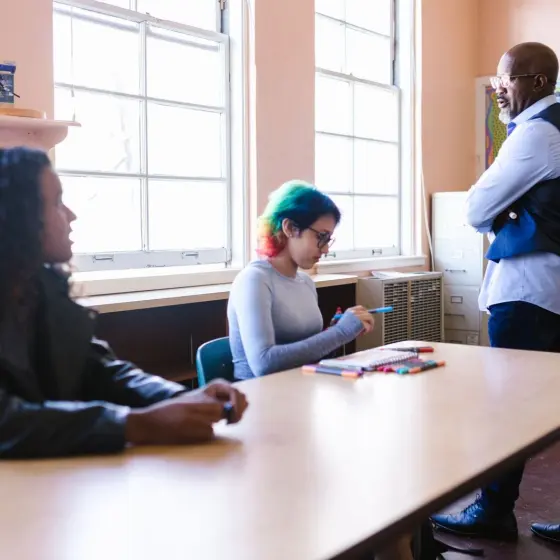
Not sure how to talk to your child’s teacher without it feeling awkward? Start with a friendly, specific question, share what you see at home, and agree on one next step together.
This is one piece of the wider topic of how to support your child’s learning at home, which the parenting section covers in more depth.
| Item | Value |
|---|---|
| Studies in the American Psychological Association review of parent involvement | 448 independent studies |
| Suggested minimum check-in rhythm | At least once a marking period |
| Suggested reply time | Within 24 hours |
| Example of a teacher’s family newsletter rhythm | One a month |
These figures come from Purdue Global’s April 3, 2024 article and Jotform’s parent-teacher communication tips. They can change, so check the sources before you rely on them.
Why a good relationship with the teacher matters
When parents are involved in their children’s schooling, students show higher academic achievement, school engagement and motivation. That is according to an American Psychological Association review of 448 independent studies, as reported in Purdue Global’s April 3, 2024 article.
The same article quotes Lisa Wright, a faculty member in the College of Social and Behavioral Sciences at Purdue Global. She says good communication “should be timely, it should be frequent, and it should be two-way.” In other words, the teacher is not the only one who has something to say.
You also hold part of the picture. Jotform’s tips point out that a student can behave differently at school than at home. One school leader quoted there says good communication gives the adults in a child’s life a fuller picture of academic progress, emotional state and social pressures, and can lead to earlier help with barriers to success.
Get ready before you reach out
A short bit of preparation makes the conversation calmer for both of you. One educator quoted by Jotform puts it simply: communication is good, but communication with a purpose is better.
Before you write or call, work through this list:
- Name your goal. Is it to understand a grade, ask about friendships, or share something that changed at home?
- Jot down what you see at home. Parents give the teacher useful insight into how their child learns, and Wright says that insight helps teachers adapt their methods to each child.
- List your questions. Good communication keeps parents informed about their child’s progress, strengths and areas that need improvement.
- Check the school’s preferred channel. Teachers are encouraged to determine a family’s contact preferences, so it helps to say what suits you and ask what suits them.
Keep the goal narrow. A single, clear topic is easier to answer well than a long list of worries sent all at once.
How to open the conversation
Tone sets the direction of the whole exchange. A school leader quoted by Jotform advises believing that the other person has the best intentions, because everyone wants the child to succeed but each person sees the child from a different angle.
Here is a simple order that follows that advice:
- Start with something positive, such as a lesson your child enjoyed or a kindness you noticed from the teacher.
- State your purpose in a sentence, for example: “I’d like to understand how reading is going.”
- Share what you see at home, then ask what the teacher sees in class.
- Agree on a next step and on how you will follow up.
Positive openings matter. Jotform’s tips note that parents who hear only negative things may be less open to working together, and the same is likely true in reverse for teachers who only hear complaints.
If the topic is homework, it can help to read up first on how to help child with homework so your questions are specific.
How often to check in, and how quickly to reply
You do not need to wait for a problem. One school leader quoted by Jotform suggests reaching out at least once a marking period to check in, even if there is nothing new to share, because there is always value in opening the door to receive feedback.
Speed matters too. A principal cited in the same piece advises responding to outreach within 24 hours, and she adds that what matters most is acknowledging the message, even if the full answer is not ready. A short note such as “Thanks, I’ll look into this and reply by Friday” keeps the line open.
Teachers use several channels, so you can choose the one that fits:
- Email or the school’s messaging app for quick questions that do not need an immediate answer.
- Newsletters and class blogs, which give families a look into the classroom. One elementary teacher quoted by Jotform sends a newsletter once a month.
- Parent-teacher meetings, which are a good chance to give and receive feedback in both directions.
- Surveys, which let you share views that may not come up in conversation.
For anything sensitive or complicated, a conversation usually beats a long message, because tone is easy to misread in writing.
When language or culture gets in the way
Not every family has the same starting point. RingCentral’s blog reports that more than half of teachers in the US worry about potential language barriers with students learning English.
The same post quotes the Every Student Succeeds Act. Under Title I, Part A, Section 1010, schools shall, to the extent practicable, give parents information in a format and a language they understand. If English is not your first language, you can ask the school for information in a language you understand.
Culture can shape conversations as well. RingCentral notes that some cultures regard direct eye contact as rude, while others see it as a sign of openness and honesty. If a teacher’s manner seems cold or overly direct, it may be a difference in style rather than a lack of care.
If conversations with a school keep falling flat, that can feed into bigger decisions, and you may want to read about how to choose a school for your child.
Frequently asked questions
How often should I contact my child’s teacher?
Show answer
One school leader quoted by Jotform suggests a check-in at least once a marking period, even when there is no news. Reach out sooner if something changes at home or you notice a problem.
What if I only ever hear bad news?
Show answer
Say so kindly and ask the teacher to share good news as well. Jotform’s tips note that parents who hear only negative things may be less open to working together.
How soon should I expect a reply?
Show answer
A principal quoted by Jotform recommends replying within 24 hours, even if the full answer is not yet available. Treat that as a helpful guide rather than a promise, since schools differ.
What if English is not my first language?
Show answer
Ask for information in a language you understand. RingCentral quotes the Every Student Succeeds Act as saying schools shall, to the extent practicable, provide information in a language parents understand.