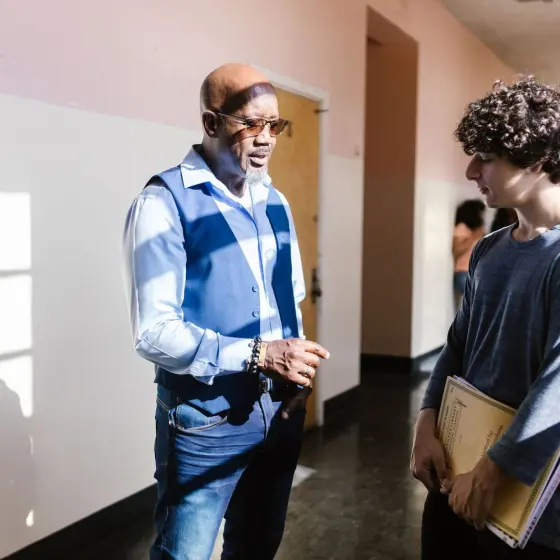
You want students to think, not just recall. The best questioning techniques for teachers mix open and closed questions, wait about three seconds, and follow up on answers.
More classroom ideas sit in the teaching tips section.
| Item | Value |
|---|---|
| Share of instructional time teachers typically spend asking questions | 35 to 50 percent |
| Average wait time in classrooms | about 1 second |
| Wait time suggested for most questions | about 3 seconds |
| Learning-focused questions needing a simple factual response (estimate) | 70-80 percent |
| Learning-focused questions leading students to explain, clarify, expand, generalize or infer (estimate) | 20-30 percent |
These figures come from the Ohio State research summary and a College of DuPage library guide. Figures can change, so check the sources before you rely on them.
Why questioning techniques shape the lesson
Questioning fills a large part of the school day. The Ohio State summary says teachers typically spend 35 to 50 percent of their instructional time asking questions.
The same summary lists many reasons to ask, and one question can serve more than one of them:
- To actively involve students in the lesson
- To increase motivation or interest
- To evaluate students’ preparation
- To review previous lessons
- To develop critical thinking skills
- To assess achievement or mastery of goals and objectives
- To stimulate independent learning
Start with the purpose. The NSW Department of Education says designing questions involves determining the purpose, and then selecting the most appropriate types of questions for that purpose. It sets out these key strategies:
- Designing higher cognitive questions
- Developing a sequence of questions
- Increasing wait time
- Responding to answers by redirecting, probing and reinforcing
Most classroom questions are not very demanding. A college library guide estimates that 70-80 percent of learning-focused questions need a simple factual response, while only 20-30 percent lead students to explain, clarify, expand, generalize or infer.
Lower and higher cognitive questions
The Ohio State summary describes lower cognitive questions as fact, closed, direct, recall and knowledge questions that involve the recall of information. Higher cognitive questions are open-ended, interpretive, evaluative, inquiry, inferential and synthesis questions. They involve the mental manipulation of information to produce or support an answer.
Neither type is “better” in every case. The summary notes that the research has mixed conclusions on whether higher-level questions always produce deeper learning, and that a combination of lower and higher questions is more effective than the exclusive use of one or the other.
Match the question to the students
- Primary students: some studies suggest lower cognitive questions may be most beneficial, and higher ones should be used more sparingly.
- Older students: higher cognitive questions should make up a higher percentage, and a high frequency (50 percent or more) is positively related to on-task behavior.
- Goal of memorising facts: lower cognitive questions are more effective.
Asking a harder question does not guarantee a better answer. Students need explicit instruction in answering these types of questions, including making inferences, according to the same Ohio State summary.
Tools for drafting open questions
Bloom’s Taxonomy is the traditional starting point, and it includes six categories: knowledge, comprehension, application, analysis, synthesis and evaluation. The NSW page also points to the Question Matrix, which comprises 36 question starters, and to the Questioning Toolkit, built on essential questions.
How to build a sequence of questions
A good lesson rarely hangs on one brilliant question. The College of DuPage guide says effective questioning plans sequences so that the cognitive level increases as the questions go on. Students are supported on the way by simpler questions.
Here is one way to shape a sequence, using question styles from that guide:
- Ask a closed question to check recall, such as “What do we call this type of text?”
- Extend it with a follow-up, such as “How did you work that out?”
- Move to an open question that allows varied answers, such as “What do you think might affect the size of the current in this circuit?”
Link every question to the lesson objectives, and keep attention on what matters. One finding in the Ohio State summary is that questions focused on important elements of a lesson result in better comprehension than those focused on unusual or interesting elements.
More questions are not always better. The summary says frequent questioning is positively related to learning facts, but simply asking a greater number of questions does not facilitate the learning of more complex material. Questions posed before reading work for older students, high-ability students and those interested in the subject, but younger students and poor readers tend to focus only on the material that will help them answer.
Questions also work as quick checks. They pair well with the formative assessment examples collected elsewhere on this site, where the aim is to see what students understand while there is still time to adjust.
Wait time: the pause that does the work
Wait time is the time a teacher allows after posing a question. In the classrooms studied by the researchers behind the Ohio State summary, the average was one second or less, and students perceived as slow or poor learners were given even less.
The College of DuPage guide agrees that the average wait time in classrooms is about 1 second. It suggests 3 seconds is about right for most questions, and complex ones may need longer.

The Ohio State summary adds detail. For lower cognitive questions, a wait-time of three seconds was most effective for achievement. For higher cognitive questions, no wait-time threshold was observed, and students seemed to become more engaged and successful the longer the teacher waited, within reason.
The payoff is wide. Increased wait-time is related to:
- Improved achievement and retention
- Greater numbers of higher cognitive responses
- Longer responses
- Decreases in interruptions
- Increased student-student interactions
Responding to answers: redirect, probe, reinforce
What you say after an answer matters as much as the question. The Ohio State summary states that a teacher’s response to students’ answers is just as important as the question asked, and the NSW strategies name redirecting, probing and reinforcing as the three moves to practise.
Probing can be as simple as the follow-up “How did you work that out?” Used after a correct answer, it asks students to show their reasoning. Used after a wrong one, it helps you see where the thinking went off course.
Students also answer more readily when conditions are right. The College of DuPage guide lists these helpful conditions:
- A classroom climate where students feel safe and know they will not be criticized or ridiculed for a wrong answer
- Prompts that give students confidence to try an answer
- A no-hands approach, where you choose the respondent rather than have them volunteer
- Wait time before an answer is required
Your reactions are also a form of feedback, so it helps to read about how to give effective feedback to students alongside your questioning practice.
Frequently asked questions
Should I always ask higher-level questions?
Show answer
No. The Ohio State summary reports mixed research conclusions and says a combination of lower and higher questions is more effective than using only one kind.
How long should I wait after asking a question?
Show answer
The College of DuPage guide suggests about 3 seconds for most questions, with longer for complex ones. Average classroom wait time is about 1 second, so even a short pause is a change.
What if students will not answer?
Show answer
Check the conditions first: a safe climate, prompts, wait time and a no-hands approach where you choose who answers. The College of DuPage guide lists these as ways to encourage responses from shy or disengaged students.
Does asking more questions improve learning?
Show answer
Only for facts. The Ohio State summary says frequent questioning relates to learning facts, but a greater number of questions does not by itself help students learn more complex material.